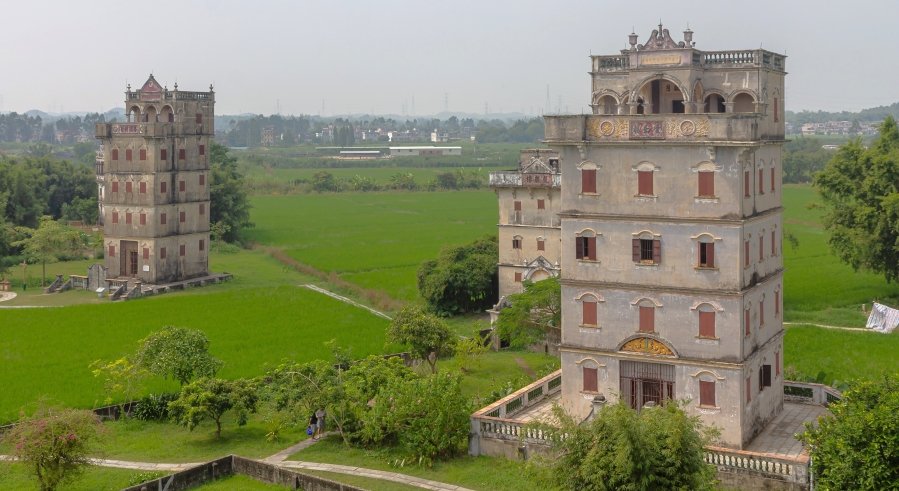
Ever heard of a skyscraper from the 1300s? Well, buckle up, because we’re about to dive into the world of Diaolou watchtowers! These aren’t your average lookout posts – we’re talking multi-story fortresses that have been keeping an eye on the Chinese countryside for centuries. Part castle, part apartment complex, and 100% awesome, these towers are like the architectural lovechild of a medieval keep and a modern high-rise. So, grab your binoculars (and maybe a hard hat), and let’s explore these sky-high sentinels that have been guarding China’s landscape long before the first modern skyscraper was even a twinkle in an architect’s eye.
Diaolou watchtowers at a glance
Picture this: it’s ancient China, and you’re a wealthy merchant living in the countryside. Life’s pretty good, except for one tiny problem – bandits keep trying to steal your stuff. What do you do? If you’re smart (and loaded), you build yourself a Diaolou watchtower!
These bad boys started popping up as early as the Ming Dynasty (1368-1644), but they really hit their stride during the Qing Dynasty (1644-1912). It wasn’t just about keeping an eye out for troublemakers, though. These towers were status symbols, ancestral halls, and community centers all rolled into one vertical package.
As time went on, the Diaolou evolved. By the late 19th and early 20th centuries, they were incorporating Western architectural elements, thanks to Chinese immigrants returning home with some fancy new ideas. It was like the ancient Chinese version of bringing home a souvenir t-shirt, except instead of “I ❤️ NY,” they brought back Baroque and Art Deco designs.
Building Details
The architecture of the Diaolou watchtowers is where things get really interesting. These structures are not your ordinary Chinese buildings. Standing anywhere between three and nine stories high, they boast a curious blend of Chinese, Greek, Roman, and even Gothic architectural elements. The returnees from America, Southeast Asia, and Europe, who built these structures, used their international exposure to design homes that stood out both visually and functionally. Diaolou watchtowers they’re tough cookies designed to withstand everything from bandit attacks to floods. Here’s what makes them tick:
Construction Materials:
- The OG towers were built with rammed earth, stone, and wood. Imagine a giant sand castle, but way more durable.
- Later versions got fancy with brick, concrete, and even steel reinforcements. It’s like they upgraded from Nokia 3310 to iPhone level of indestructibility.
Height and Floors:
- These aren’t your average two-story homes. We’re talking anywhere from 3 to 7 floors, with some reaching up to 17 meters (about 56 feet) high.
- Each floor usually had a specific purpose: ground floor for storage, upper floors for living, and the top floor for keeping watch. It’s like a vertical mullet – business on the bottom, party in the middle, serious lookout on top.
Defensive Features:
- Narrow windows and gun slots? Check.
- Thick walls that could withstand gunfire? Double-check.
- Some even had hidden escape tunnels. James Bond would be proud.
Architectural Styles:
- Early Diaolou were all about that classic Chinese look – think upturned eaves and intricate carvings.
- Later towers went full-on fusion, mixing Chinese elements with Western styles like Baroque, Roman, and Gothic. It’s like the architectural equivalent of putting soy sauce on spaghetti – sounds weird, looks amazing.
Interior Layout:
- The ground floor was often used for storage or as a reception area. You know, in case any bandits wanted to schedule an appointment.
- Upper floors were divided into living quarters, with some fancier towers boasting luxuries like running water and electricity. Talk about high-rise living!
- The top floor was usually an open space for keeping watch, often with a balcony for 360-degree views. Perfect for spotting trouble or just enjoying a sunset with your morning tea.
Communal Aspects:
- Some Diaolou were built by entire villages as a shared safe house. It’s like a vertical gated community, minus the snooty HOA.
- These communal towers often had larger gathering spaces and could house multiple families during times of danger.
Decorative Elements:
- Despite their defensive purpose, many Diaolou were decked out with beautiful decorations.
- We’re talking carved stone balustrades, colorful tiles, and even Western-style sculptures. Because if you’re going to hide from bandits, you might as well do it in style.
Adaptations to Environment:
- In flood-prone areas, Diaolou were built on raised platforms. It’s like Noah’s Ark, but stationary and a lot more stylish.
- Some towers in Kaiping even incorporated fireplaces – a nod to the returning immigrants who got used to Western comforts.
Diaolou watchtowers in all their multi-story, multi-cultural glory. They’re not just buildings, they’re time capsules of Chinese history, standing tall and proud against the sky.
Locations of Diaolou Watchtowers
Now, you might be wondering where you can feast your eyes on these architectural marvels. Well, pack your bags (and maybe a good pair of hiking boots), because we’re going on a Diaolou tour:
Kaiping, Guangdong Province:
- This is the motherlode of Diaolou towers. UNESCO even gave it a World Heritage Site thumbs up in 2007.
- Famous clusters include Zili Village, Jinjiangli Village, and Sanmenli Village. It’s like a theme park for architecture nerds.
Taishan, Guangdong Province:
- Not to be outdone by its neighbor Kaiping, Taishan has its fair share of impressive towers.
- Check out the Sijia Lou for some serious tower goals.
Enping, Guangdong Province:
- Keeping up the Guangdong trend, Enping boasts some beautiful examples of Diaolou architecture.
- The Encheng Lou is a must-see if you’re in the area.
Xinhui District, Jiangmen City, Guangdong Province:
- Sensing a pattern here? Guangdong is basically Diaolou central.
- The Xinhui Diaolou are known for their unique blend of Chinese and Western styles.
Scattered locations in Fujian Province:
- While not as concentrated as in Guangdong, Fujian has some impressive Diaolou of its own.
- These tend to be older and more traditional in style.
Remember, while many Diaolou are well-preserved and open to visitors, others are privately owned or in various states of repair. Always respect local guidelines and private property. And maybe bring a telescope – some of these views are out of this world!
Final Thoughts
As we wrap up our sky-high journey through the world of Diaolou watchtowers, it’s hard not to be impressed. These towers are more than just old buildings – they’re a testament to human ingenuity, a blend of cultures, and let’s face it, a pretty cool way to keep your stuff safe.
From their humble beginnings as lookout posts to their evolution into symbols of wealth and cultural fusion, Diaolou watchtowers have seen it all. They’ve weathered storms (literally), stood up to bandits, and even managed to look good doing it. In a world where we’re always looking to the future, these towers remind us that sometimes, the past had some pretty great ideas too.
So next time you’re in China, take a break from the Great Wall and the Forbidden City (they’re not going anywhere) and check out these vertical villages. Who knows? You might just find yourself inspired to add a watchtower to your own home. Just check with your local zoning board first – and maybe invest in a really good ladder. / Photo credit