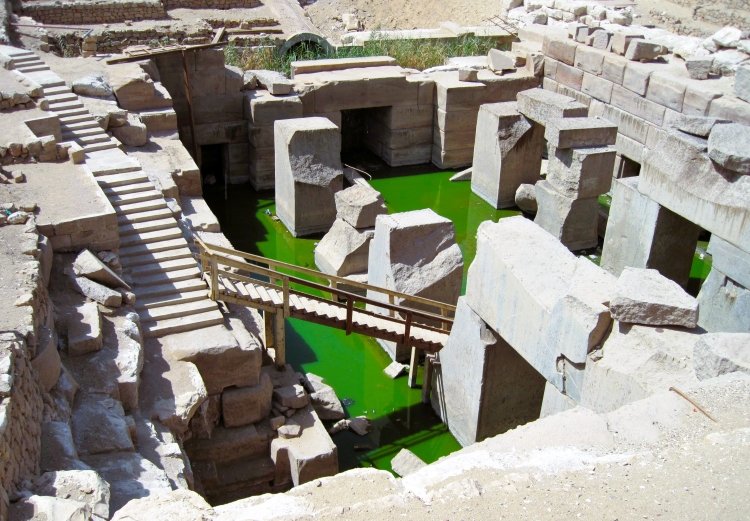
Imagine stumbling upon a 3,000-year-old temple that looks like it could’ve been built by ancient aliens. Welcome to the Osireion, folks! Tucked away in Abydos, Egypt, this mind-boggling structure has been turning heads and sparking wild theories since its discovery in 1902. With its massive stone blocks and underwater chambers, the Osireion is like the bad boy of Egyptian temples – mysterious, complex, and totally irresistible. So, grab your Indiana Jones hat, and let’s dive into one of Egypt’s most puzzling archaeological sites!
Abydos, the ancient Egyptian city where our star attraction sits, was basically the Vegas of its time – if Vegas was all about worshipping the dead instead of slot machines. Known as the cult center of Osiris, the god of the afterlife, Abydos was THE place to be buried if you wanted a first-class ticket to the Egyptian afterlife.
Enter the Osireion, a temple that’s had archaeologists scratching their heads for over a century. Built during the reign of Seti I in the New Kingdom period (around 1290 BCE), this temple was designed to be the symbolic tomb of Osiris himself. But here’s where it gets weird – the Osireion’s architecture is so different from other New Kingdom temples that some folks think it might be way older, possibly dating back to the Old Kingdom or even earlier.
The temple’s unique design, with its megalithic style and underground water features, has led to comparisons with structures like Stonehenge and even the alleged lost city of Atlantis. It’s like someone dropped a prehistoric monument right in the middle of ancient Egypt, and nobody can quite figure out how or why.
Main Attractions:
- The Central Island: Picture a massive stone platform surrounded by water – that’s the heart of the Osireion. This “island” was supposedly where Osiris’ body rested, making it the ancient Egyptian equivalent of a celebrity grave site.
- Megalithic Pillars: Surrounding the central island are 17 colossal pillars, each weighing up to 100 tons. These bad boys make the stones at Stonehenge look like pebbles in comparison.
- The Mysterious Flower of Life: On one of the temple’s walls, you’ll find a peculiar geometric pattern known as the Flower of Life. It’s like ancient graffiti, but way cooler and more mystical.
- Underground Passages: A network of spooky underground corridors adds to the temple’s air of mystery. Just try not to imagine mummies coming to life as you explore.
- The False Door: This ornately decorated stone slab was believed to be a gateway between the world of the living and the dead. Talk about a high-stakes door!
Off-the-Beaten-Path Recommendations:
- The Osireion’s Rear Entrance: Most tourists enter through the front, but sneaking around to the back gives you a unique perspective on how the temple merges with the natural landscape.
- Sunset Viewing: If you can swing it, watching the sunset from the Osireion is like seeing the ancient world come alive. The play of light on the massive stones is pure magic.
- The Surrounding Necropolis: While everyone’s focused on the Osireion, take some time to explore the lesser-known tombs in the area. They’re like the supporting actors who sometimes steal the show.
- Local Folklore: Chat with the local guides about the legends surrounding the Osireion. Some of their stories are wilder than any Hollywood script!
Travel Tips and Practical Information
- Getting There: Abydos is about a 4-hour drive from Luxor. Join a tour or hire a private car, because public transport to the site is about as rare as a pharaoh’s curse.
- Best Time to Visit: Winter months (October to April) are ideal. Unless you enjoy feeling like a mummy in an oven, avoid summer at all costs.
- Entry Fees: As of 2023, entry to the Seti I Temple complex (which includes the Osireion) costs about 180 Egyptian pounds (roughly $6 USD). Always check for the most current prices.
- Guided Tours: Consider hiring a knowledgeable guide. The Osireion’s history is complex, and a good guide can help separate fact from fiction (and there’s a lot of fiction).
- Photography: Bring your camera, but check current rules about photography inside the temple. And maybe leave the drone at home, unless you fancy a chat with Egyptian authorities.
Nearby Points of Interest & Landmarks
- Temple of Seti I: Right next door to the Osireion, this temple is like the straight-A student to the Osireion’s rebel. It’s beautifully preserved and full of colorful reliefs.
- Umm el-Qa’ab: This royal necropolis is where Egypt’s earliest kings were buried. It’s like a who’s who of pharaonic history.
- Temple of Ramesses II: Another architectural marvel, just a stone’s throw from the Osireion. It’s smaller than Seti I’s temple but packs a historical punch.
- The Great Temple of Abydos: Also known as the Memmonium, this temple complex is a testament to the grand vision of Seti I and Ramesses II.
Final Thoughts
The Osireion is like that one friend who’s always full of surprises – just when you think you’ve got it figured out, it throws you another curveball. Whether you believe it’s a masterpiece of New Kingdom engineering or proof of a lost civilization, one thing’s for sure: it’ll leave you with more questions than answers.
As you stand among those massive stone blocks, feeling dwarfed by the weight of history, you can’t help but marvel at the ingenuity and mystery of ancient Egypt. The Osireion reminds us that sometimes, the most fascinating stories are the ones we’re still trying to understand.
So, pack your sense of wonder (and maybe a couple of conspiracy theories), and get ready to experience one of Egypt’s most enigmatic treasures. Just don’t blame us if you come back convinced that aliens built the pyramids! / photo credit