Introduction:
There’s something magical about crossing the Brooklyn Bridge. Whether you’re walking, biking, or just taking in the views, this iconic landmark provides a stunning glimpse into New York City’s history while offering some of the best skyline views you’ll ever see. Connecting Manhattan and Brooklyn, the Brooklyn Bridge has been a symbol of strength and resilience since it opened in 1883. It’s not just a way to get from point A to point B—it’s a journey through time, architecture, and the vibrant energy of NYC. Let’s explore the story behind this historic bridge and why it remains one of the city’s most beloved spots.
History:
The Brooklyn Bridge’s story is as epic as the city it connects. Back in the mid-19th century, Manhattan and Brooklyn were separate cities, and traveling between them required a ferry ride across the East River. This wasn’t always convenient, especially in bad weather. Enter John Augustus Roebling, a German-born engineer who had a vision for a bridge that could not only connect these two bustling areas but also stand as a triumph of modern engineering.
Roebling’s design was groundbreaking for its time, proposing the use of steel wire suspension cables—something that had never been done on such a large scale. Unfortunately, Roebling didn’t live to see his masterpiece completed. In 1869, while conducting surveys for the bridge, his foot was crushed in a freak accident. He died of tetanus shortly after, leaving his son, Washington Roebling, to take over the project.
The construction of the Brooklyn Bridge was no easy feat. The workers, known as “sandhogs,” had to dig deep into the riverbed to create the foundations for the bridge’s towers. Many suffered from a condition known as “the bends” due to the pressure in the caissons (watertight chambers used in underwater construction). Tragically, Washington Roebling also became ill from the bends, leaving him bedridden for much of the remaining construction. However, the project didn’t stop. His wife, Emily Warren Roebling, stepped in to relay his instructions to the workers, making her an unsung hero in the bridge’s completion.
After 14 years of construction, the Brooklyn Bridge was finally opened to the public on May 24, 1883, with a grand celebration. At the time, it was the longest suspension bridge in the world, spanning 1,595 feet across the East River. The bridge quickly became a symbol of progress, not just for New York, but for the entire country. More than 150,000 people crossed the bridge on its first day, with Emily Roebling being the first to walk across, symbolizing her crucial role in its completion.
Over the years, the Brooklyn Bridge has weathered its share of challenges, from extreme weather to increased traffic demands. But thanks to regular maintenance and care, it stands strong today, welcoming millions of visitors and commuters every year.
Structure Details:
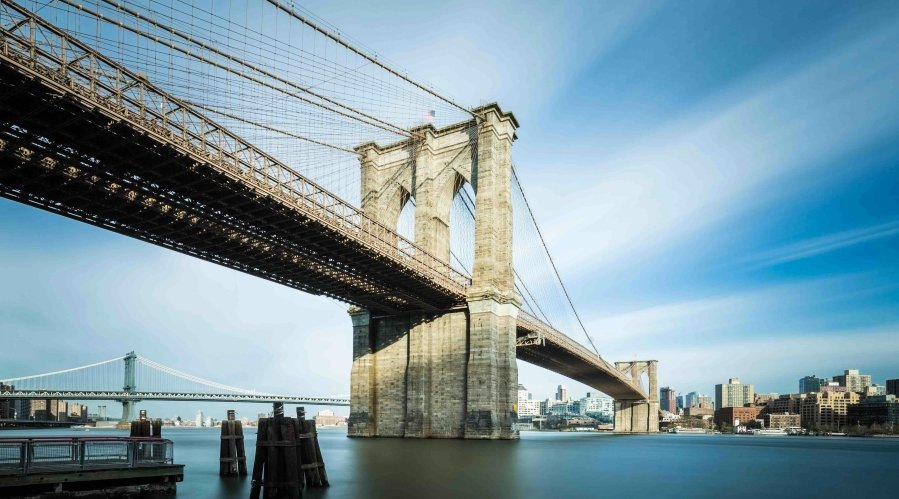
The Brooklyn Bridge is an engineering marvel, particularly for its time. Built as a suspension bridge, its most striking features are the two towering Gothic-style stone pylons, which rise 276 feet above the water. These towers are made of limestone, granite, and cement, and they serve as the anchors for the massive steel cables that support the bridge. Each cable is made from thousands of individual steel wires, and collectively, they provide enough strength to support the weight of traffic for more than a century.
The bridge’s total length is 5,989 feet, with a main span of 1,595 feet between the two towers. The design was revolutionary because it combined both a suspension and a cable-stayed bridge design, allowing it to support more weight over longer distances. A wide pedestrian promenade sits above the vehicle lanes, making the Brooklyn Bridge one of the few bridges in New York where you can walk or bike across while taking in views of the city and the river below.
Key Features:
- Gothic Towers: The two iconic stone towers with pointed arches give the bridge a cathedral-like look and are some of the most recognizable architectural features in New York City.
- Pedestrian Promenade: Unlike many bridges, the Brooklyn Bridge has a dedicated walkway for pedestrians and cyclists, offering sweeping views of the Manhattan skyline, Statue of Liberty, and the East River.
- Suspension Cables: The bridge is supported by four massive steel cables, each over 3,500 feet long, that hold up the roadway and have become a signature visual element of the bridge.
- Hybrid Design: Combining elements of both suspension and cable-stayed bridges, the Brooklyn Bridge was a pioneer in bridge construction and remains one of the most innovative designs of its time.
Getting There:
Visiting the Brooklyn Bridge is easy, no matter how you’re traveling. If you’re starting from Manhattan, the pedestrian entrance is located near City Hall on Centre Street. You can take the subway to Brooklyn Bridge-City Hall Station on the 4, 5, or 6 trains, or the Chambers Street Station on the J and Z lines.
If you’re coming from Brooklyn, the best access point is from DUMBO (Down Under the Manhattan Bridge Overpass), near Cadman Plaza East and Tillary Street. You can take the A or C trains to High Street Station or the F train to York Street Station.
Walking the bridge takes about 30 minutes one way, but you’ll likely want to stop and snap a few photos along the way, so give yourself some extra time to soak it all in.
Final Thoughts:
The Brooklyn Bridge isn’t just a way to get between boroughs—it’s a symbol of New York’s ambition, resilience, and creativity. Whether you’re a local or a visitor, walking across this historic structure is like stepping into the city’s past while enjoying its modern skyline. It’s a perfect mix of old-world charm and contemporary vibrancy. So, lace up your sneakers, grab your camera, and take a stroll across one of the world’s most famous bridges—you won’t regret it!