In the annals of military aviation, few names resonate as powerfully as that of Manfred von Richthofen, better known as the Red Baron. His story is one of skill, courage, and the changing face of warfare in the early 20th century. This article delves into the life, achievements, and lasting legacy of World War I’s most famous fighter pilot.
Early Life and Military Career
Born on May 2, 1892, in Breslau, Lower Silesia (now Wrocław, Poland), Manfred von Richthofen came from a prominent Prussian aristocratic family. From a young age, he was groomed for a military career, enrolling in military school at 11. His early years were marked by a passion for hunting and horseback riding, skills that would later serve him well in the skies.
When World War I erupted in 1914, Richthofen initially served as a cavalry reconnaissance officer on both the Eastern and Western Fronts. However, the static nature of trench warfare quickly rendered cavalry obsolete, leading him to seek a transfer to the Imperial German Army Air Service in May 1915.
The Birth of an Ace
Richthofen’s transition to aviation was not immediately successful. He struggled with airsickness and initially served as an observer rather than a pilot. It wasn’t until August 1915 that he began pilot training, earning his license in June 1916.
His first confirmed aerial victory came on September 17, 1916, over Cambrai, France. This marked the beginning of a meteoric rise to fame. Richthofen’s natural hunting instincts, exceptional marksmanship, and tactical brilliance quickly set him apart from his peers.
The Red Baron Takes Flight
In January 1917, Richthofen received command of Jasta 11, an elite fighter squadron. It was around this time that he began flying his signature Albatros D.III painted bright red. This bold color choice, coupled with his aristocratic title, led to his famous moniker: the Red Baron.
Under Richthofen’s leadership, Jasta 11 became the most successful fighter squadron of World War I. April 1917 was particularly successful, with the unit claiming 89 enemy aircraft, 21 of which were credited to Richthofen himself. This month became known as “Bloody April” and cemented the Red Baron’s status as Germany’s top ace.
The Red Baron’s Aircraft
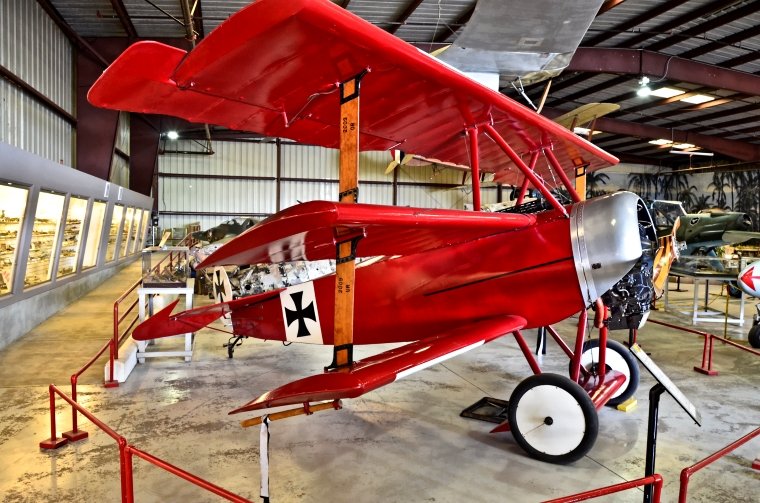
Manfred von Richthofen flew several different aircraft types during his career, each contributing to his legend in its own way. His most famous aircraft, however, was undoubtedly the Fokker Dr.I triplane.
- Albatros D.II and D.III: Richthofen achieved many of his early victories in these nimble biplanes. The Albatros D.III, in particular, was a formidable fighter with excellent climbing and diving capabilities. It was in an Albatros that Richthofen first painted his aircraft entirely red.
- Halberstadt D.II: This was the aircraft in which Richthofen scored his first confirmed victory. Although not as advanced as later fighters, it played a crucial role in launching his career as an ace.
- Fokker Dr.I Triplane: This is the aircraft most closely associated with the Red Baron. The Dr.I was a highly maneuverable triplane that excelled in dogfights. Its distinctive three-wing design made it instantly recognizable in the skies over the Western Front. Richthofen began flying the Dr.I in September 1917 and scored 19 of his 80 victories in this aircraft. Key features of the Fokker Dr.I included:
- Engine: Oberursel UR.II 9-cylinder rotary engine, 110 hp
- Wingspan: 7.19 meters (23 ft 7 in)
- Maximum speed: 185 km/h (115 mph)
- Armament: Two 7.92 mm (.312 in) LMG 08/15 machine guns
The Dr.I’s excellent rate of climb and its ability to turn tightly made it a deadly opponent in the hands of a skilled pilot like Richthofen. However, it was slower than some contemporary fighters and less effective at higher altitudes.
- Fokker D.VII: In the last months of his life, Richthofen also flew the new Fokker D.VII. This aircraft would go on to be considered one of the best fighter planes of World War I, but the Red Baron’s experience with it was limited due to his untimely death.
Richthofen’s preference for painting his aircraft bright red was not just for showmanship. It was a calculated risk that intimidated his enemies and rallied his own men. The sight of a bright red aircraft swooping out of the sun struck fear into the hearts of Allied pilots and earned Richthofen his famous nickname.
The Red Baron’s mastery of these aircraft, particularly the Fokker Dr.I, played a crucial role in cementing his status as the ace of aces. His intimate understanding of his planes’ capabilities allowed him to push them to their limits, often achieving victory against seemingly impossible odds.
Tactics and Technology
Richthofen’s success was not merely a product of individual skill but also of his innovative tactics. He emphasized teamwork, often leading his squadron in tight, well-coordinated attacks. He also understood the importance of surprise, frequently approaching enemy aircraft from above with the sun at his back to conceal his approach.
The Red Baron was also known for his meticulous preparation. He studied the strengths and weaknesses of both German and Allied aircraft, always seeking to maximize his technological advantage. In 1917, he began flying the Fokker Dr.I triplane, the aircraft most commonly associated with his legend.

The Man Behind the Myth
Despite his fearsome reputation, Richthofen was known for his chivalrous nature. He respected his opponents and was said to be deeply affected by the deaths he caused. After each victory, he would land near the downed enemy aircraft if possible, to confirm the kill and sometimes to pay respects to the fallen pilot.
Richthofen was also a skilled propagandist, understanding the value of his public image. He wrote an autobiography, “Der Rote Kampfflieger” (The Red Fighter Pilot), which became a bestseller in Germany. His fame boosted morale on the home front and struck fear into Allied pilots.
The Final Flight
As Richthofen’s victory count grew, so did his notoriety among Allied forces. On July 6, 1917, he sustained a serious head wound during combat, which may have affected his judgment in subsequent months.
On April 21, 1918, Richthofen pursued a Sopwith Camel piloted by novice Canadian pilot Lieutenant Wilfrid May deep into Allied territory. In the ensuing dogfight, Richthofen’s aircraft was struck by a single bullet, forcing him to make an emergency landing near Vaux-sur-Somme, France. He died moments after touching down, having scored 80 confirmed aerial victories.
The exact circumstances of Richthofen’s death remain controversial. While officially credited to Canadian Captain Arthur Roy Brown, many historians now believe the fatal shot came from Australian ground forces.
Legacy and Impact
Manfred von Richthofen’s impact on military aviation and popular culture cannot be overstated. His tactical innovations influenced fighter combat for decades to come. The Red Baron’s name has become synonymous with aerial combat excellence, featured in countless books, films, and even popular songs.
In death, Richthofen was honored by both sides of the conflict. He received a full military funeral from the Allied forces, a testament to the respect he commanded even among his enemies. Today, his legacy lives on in aviation museums, historical reenactments, and the enduring fascination with World War I aerial combat.
The Red Baron in Popular Culture
The legend of the Red Baron has transcended historical boundaries, becoming a significant part of popular culture in the century since his death. His larger-than-life persona and dramatic exploits have inspired countless creative works across various media:
- Literature: Numerous books have been written about the Red Baron, ranging from historical biographies to fictional adventures. Notable works include “The Red Baron” by Manfred von Richthofen himself, and “The Red Knight of Germany” by Floyd Gibbons.
- Film and Television: The Red Baron has been a popular subject in cinema and TV. Some notable portrayals include:
- “Von Richthofen and Brown” (1971), directed by Roger Corman
- “The Red Baron” (2008), a German-British biographical film
- Appearances in historical documentaries on The History Channel and Discovery Channel
- Music: Perhaps the most famous musical reference to the Red Baron is the 1966 hit song “Snoopy vs. The Red Baron” by The Royal Guardsmen. This novelty song, featuring Charles Schulz’s cartoon character Snoopy as a World War I flying ace, brought the Red Baron to a new generation.
- Comic Books and Graphic Novels: The Red Baron has appeared in various comic book series, both as a historical figure and as a fictional character. Notably, he’s been featured in some issues of DC Comics’ “Enemy Ace” series.
- Video Games: Flight simulation and combat games often include the Red Baron or aircraft inspired by his famous Fokker Dr.I triplane. Examples include:
- “Red Baron” (1990), a combat flight simulator by Dynamix
- Appearances in the “Battlefield” series of first-person shooter games
- Toys and Models: Model kits of the Red Baron’s aircraft, particularly the Fokker Dr.I, are popular among hobbyists. Action figures and other toys have also been produced, often tied to the Snoopy character.
- Advertising: The image of the Red Baron has been used in marketing campaigns, most notably by the frozen pizza brand “Red Baron,” which uses a caricature of Richthofen as its logo.
- Cultural References: The term “Red Baron” has entered common usage as a metaphor for any acknowledged expert in their field, particularly in competitive or high-stakes environments.
This enduring presence in popular culture speaks to the lasting fascination with the Red Baron’s story. It combines elements of heroism, tragedy, and the romantic notion of aerial combat in the early days of flight. The continued reinterpretation of his legend in various media ensures that the name Manfred von Richthofen remains familiar to audiences far removed from the era of World War I.
Conclusion
The story of the Red Baron is more than just a tale of aerial derring-do. It’s a reflection of a world in transition, where ancient notions of chivalry collided with the brutal realities of modern warfare. Manfred von Richthofen embodied this contradiction, a nobleman who became the face of a new kind of war.
His life and death continue to captivate us, not just for his remarkable skills as a pilot, but for what he represents: the human element in the midst of mechanized slaughter, the individual hero in an age of anonymous mass warfare. The Red Baron’s legend, like his distinctive scarlet triplane, still soars in our collective imagination, a vivid reminder of a bygone era of aerial combat.
More than a century after his final flight, the Red Baron’s influence persists, his story retold and reimagined for new generations. This enduring fascination underscores the timeless appeal of his legend – a tale of skill, courage, and the complex nature of heroism in wartime. As long as there is interest in aviation history and the human stories behind great conflicts, the Red Baron will continue to capture our imagination and inspire new interpretations in popular culture.