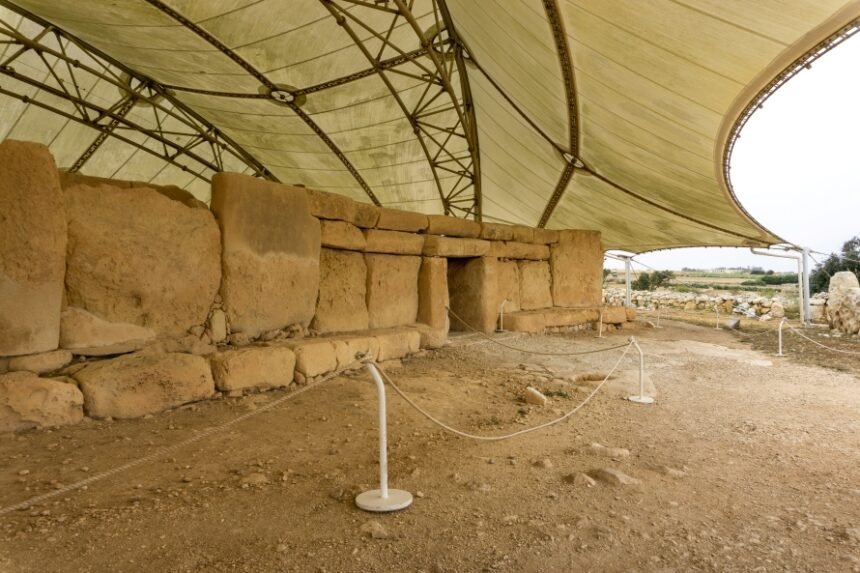
Located on Malta’s southern cliffs, the Hagar Qim Temple complex stands as a testament to humanity’s earliest architectural achievements. Dating back to around 3600-3200 BCE, these massive limestone temples have baffled archaeologists and visitors alike with their sophisticated design and astronomical alignments. Often called the “Standing Stones,” Hagar Qim offers a fascinating glimpse into a mysterious civilization that flourished on this Mediterranean island over 5,000 years ago.
At a glance
The name “Hagar Qim” means “standing stones” in Maltese, and it’s easy to see why. The temple’s massive megalithic blocks, some weighing over 20 tons, were somehow transported and erected by a civilization that predated the Egyptian pyramids. Built during Malta’s Temple Period, Hagar Qim represents the peak of the island’s prehistoric architectural achievements.
What makes this site particularly intriguing is its astronomical significance. The temple’s main entrance aligns perfectly with the sunrise during summer solstice, while various other apertures track different celestial events throughout the year. This suggests that its builders possessed sophisticated knowledge of astronomy and mathematics, challenging our assumptions about prehistoric societies.
The temple’s construction coincided with a period of remarkable cultural development in Malta, when the island’s inhabitants created some of the world’s earliest free-standing stone buildings and produced distinctive artwork and figurines.
Main Site Description
The Hagar Qim complex is a masterpiece of prehistoric architecture, featuring multiple temple structures built with massive limestone blocks. The main temple’s façade is particularly impressive, with its monumental doorway flanked by some of the largest megaliths ever used in Maltese temple construction.
Inside, the temple follows a typical cloverleaf floor plan, with a series of semi-circular chambers branching off from a central corridor. Each chamber likely served different ritualistic purposes, as evidenced by the various altars and decorated blocks found within.
One of the most remarkable features is the “oracle hole” – a small aperture that aligns with the sunrise during summer solstice, flooding the interior with light. Nearby, you’ll find the famous “fat lady” statues and various decorated stones featuring intricate spiral patterns and animal carvings.
The site also includes several unique architectural features:
- The Misqa Tanks: Ancient water collection systems carved into the limestone
- The Portal Trilithon: A massive doorway made from three enormous stones
- The External Bench: A continuous stone bench running along the temple’s façade
- The Calendar Stone: A perforated block that may have been used to track seasons
Myths and Legends
Local folklore has woven rich tapestries of stories around Hagar Qim over the millennia. One persistent legend claims the temples were built by giants, which explains the massive size of the stones. Another tale suggests the complex was a sacred healing site where ancient priestesses performed ritualistic cures.
The Legend of Sansuna
Perhaps the most famous legend associated with Hagar Qim is that of Sansuna, a giantess who allegedly built the temples. According to local tradition, Sansuna carried the massive stones while nursing her baby, creating the entire complex single-handedly. The legend says she did this by balancing the megaliths on her head while carrying her child, explaining why some of the stones show curious indentations that locals claim are her fingerprints.
The Sansuna legend reflects the deep connection between the temple and fertility worship, as evidenced by the numerous “fat lady” statues found at the site. These figurines, representing the Mother Goddess, suggest that Hagar Qim may have been a center for fertility rituals and celebrations.

Travel Tips and Practical Information
- Best visiting times: Early morning or late afternoon to avoid the intense Mediterranean sun
- Duration: Plan for 2-3 hours to fully explore the site
- Tickets: Combined ticket available with nearby Mnajdra Temples
- Protection: The site is covered by a protective tent to prevent weathering
- Accessibility: Well-maintained pathways, but some areas require careful navigation
- Photography: Allowed throughout the site, best light conditions in morning hours
- Visitor Center: Excellent interactive displays and 4D experience
- Guided Tours: Available daily in multiple languages
- Essential Items: Sun protection, water, comfortable walking shoes
Nearby Points of Interest & Landmarks
After exploring Hagar Qim, there are several other incredible spots worth checking out nearby:
- Mnajdra Temple: Located just a short walk from Hagar Qim, Mnajdra is another awe-inspiring megalithic temple with its own set of mysteries.
- Blue Grotto: A stunning sea cave nearby where you can take boat tours to see the glowing blue waters.
- Dingli Cliffs: For spectacular views of the Mediterranean, head over to these towering cliffs. They’re perfect for a scenic hike.
- Qrendi Village: The nearby village of Qrendi offers charming streets, local restaurants, and a chance to experience Maltese culture.
- Dingli Cliffs (4 km )
- Ghar Dalam Cave and Museum (3 km )
- Traditional fishing village of Marsaxlokk (6 km)
- Prehistoric cart ruts at “Clapham Junction” (2 km)
- St. Paul’s Catacombs (8 km)
Final Thoughts
Hagar Qim stands as more than just an archaeological wonder, it’s a gateway to understanding humanity’s earliest attempts at monumental architecture. While many questions about its builders remain unanswered, the site continues to inspire awe and wonder in visitors from around the world. Whether you’re a history enthusiast, an architecture buff, or simply curious about ancient civilizations, Hagar Qim offers an unforgettable journey into Malta’s mysterious prehistoric past. Its enduring presence on Malta’s limestone cliffs reminds us that some mysteries of human ingenuity and determination transcend time itself.