Introduction:
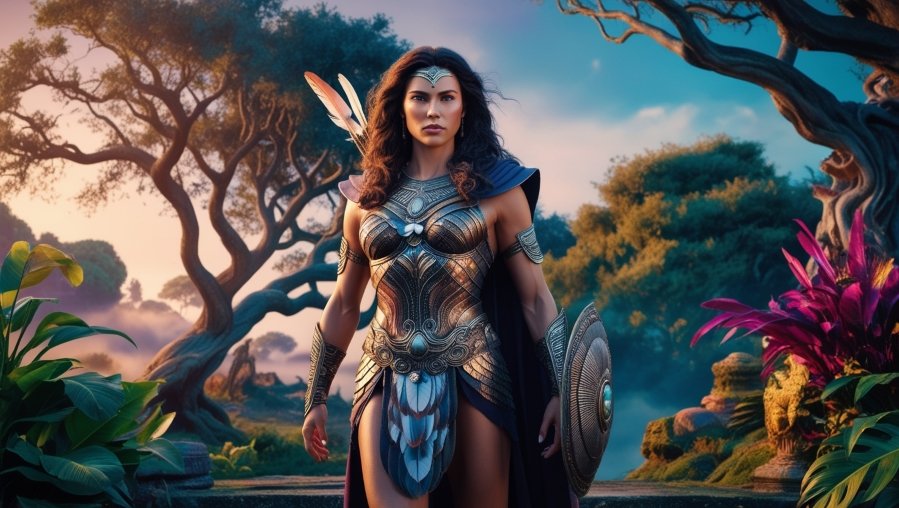
Imagine a society made up entirely of fierce warrior women, mastering the art of combat and living free from male dominance. Sounds like something straight out of a blockbuster, right? Well, that’s the Amazons for you! These legendary women, known for their strength, bravery, and independent lifestyle, have fascinated historians, poets, and storytellers for centuries. From ancient Greece to modern pop culture, the Amazons have remained a symbol of feminine power and mystery. But who were they? Were they real? Let’s explore their origins, their place in mythology, and whether the Amazons were more than just a myth.
Historiography:
The Amazons have sparked curiosity and debate among historians for centuries. The earliest mentions of the Amazons come from Greek mythology, where they are depicted as fierce warriors who were equals, if not superior, to men in battle. They first appeared in Homer’s Iliad, fighting against the Greeks in the Trojan War. Over time, their legend spread across different cultures, and their stories were retold with variations, from ancient Persia to medieval Europe.
Greek historians, such as Herodotus, often debated whether these warrior women were based on real tribes. Some believed they were inspired by the Scythians, a nomadic people known for their horse-riding and archery skills, while others dismissed them as purely fictional creations. In the 20th century, archaeological discoveries in Eurasia revealed graves of female warriors, reigniting the discussion about the historical basis for Amazons. The line between myth and reality continues to blur, making the Amazons an enduring subject of fascination.
Origins & Name:
The name “Amazon” is believed to have Greek origins, though its meaning remains a topic of debate. One popular theory is that it derives from the Greek word “a-mazos,” meaning “without a breast.” This reflects the belief that Amazons removed one of their breasts to better wield a bow and arrow in combat. However, this idea is likely more symbolic than literal. Another theory suggests the name comes from an ancient Iranian term meaning “warrior” or “combatant.”
In Greek mythology, the Amazons were said to live far from the Greek mainland, often in regions such as the Caucasus, Scythia, or along the Black Sea. They were thought to be daughters of Ares, the god of war, and Harmonia, a nymph. Raised in a society that valued strength, courage, and independence, the Amazons were said to reject traditional female roles and instead embraced a lifestyle centered on combat, hunting, and warfare.
Mythology:
In myth, the Amazons were often portrayed as rivals to the Greek heroes. They appear in several famous Greek myths, including the labors of Heracles and the adventures of Theseus. One of the most well-known tales is that of Heracles’ quest to obtain the girdle of Hippolyta, the queen of the Amazons. According to the myth, Hippolyta was willing to give him the girdle, but Hera, the queen of the gods, intervened, leading to a tragic battle in which many Amazons were killed.
The Amazons also fought in the Trojan War, siding with the Trojans against the Greeks. Penthesilea, another Amazon queen, famously dueled with Achilles, one of Greece’s greatest warriors. Though Achilles ultimately killed her, the myth suggests he was so struck by her beauty and bravery that he fell in love with her at the moment of her death.
Despite their frequent portrayal as opponents of Greek heroes, the Amazons were also admired for their strength, courage, and warrior ethos, embodying ideals that both intrigued and unsettled the ancient Greeks.
The Culture of the Amazons:
While the Amazons of myth lived in an all-female society, they were not completely cut off from men. In some versions of the story, the Amazons visited nearby tribes or communities to have children. Male offspring were often sent back to their fathers or abandoned, while females were raised to become warriors.
Amazons were often associated with horseback riding, archery, and the use of spears. These skills made them formidable opponents in battle. Their society was said to be matriarchal, with women holding all positions of power, from ruling queens to military commanders. The Amazons’ rejection of traditional gender roles was likely one of the reasons they were both feared and admired by male-dominated societies like ancient Greece.
Although the Amazons are often depicted as living on the fringes of the known world, recent archaeological discoveries suggest that their stories may have been inspired by real-life nomadic tribes. Graves discovered in the Eurasian steppes contained the remains of women buried with weapons, indicating that some women in these societies were indeed warriors. While it’s impossible to say definitively whether the Amazons were real, there is evidence to suggest that stories of female warriors were more than just a product of ancient imagination.
Trivia:
- In Greek art, Amazons were often depicted wearing a mix of Greek and Persian clothing, symbolizing their status as outsiders.
- The Wonder Woman character, created in the 20th century, is based on Amazon mythology. Her homeland, Themyscira, is inspired by the Amazon’s mythological lands.
- The Amazon River in South America is said to have gotten its name from early European explorers, who believed they encountered warrior women in the region.
- Archaeological discoveries in Russia and Kazakhstan have uncovered tombs of female warriors, leading some to believe that the Amazons were inspired by real-life women from nomadic tribes.
Final Thoughts: Myth or Reality?
So, were the Amazons real? It’s likely that the truth lies somewhere in between. While the Amazons as described in Greek mythology were probably a product of myth-making, their stories were likely inspired by real female warriors from nomadic tribes. The discovery of female skeletons buried with weapons suggests that some women in ancient Eurasia did live and die as warriors, challenging traditional gender roles. Whether or not the Amazons existed as a distinct tribe, they remain a powerful symbol of strength, independence, and resilience, continuing to inspire and intrigue us today.