




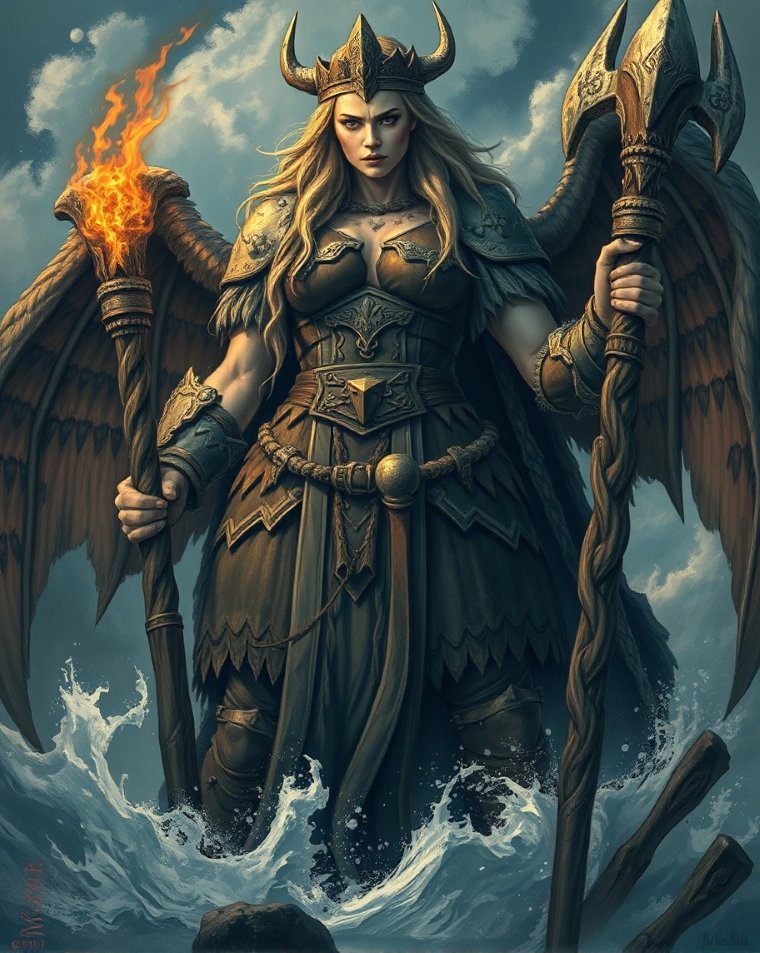
Angrboða, a name that strikes both fear and fascination in the annals of Norse mythology, is a powerful and enigmatic figure whose influence reaches far beyond her own story. Often overshadowed by more prominent deities, Angrboða plays a crucial role in the cosmic drama of the Norse pantheon, particularly through her infamous offspring.
Origins and Identity
Angrboða, whose name can be translated as “the one who brings grief” or “she who offers sorrow,” is a female jötunn, or giant, from the race of beings that often stand in opposition to the Æsir gods. While giants are frequently portrayed as adversaries in Norse myths, Angrboða’s significance stems not from direct conflict but from her role as a mother of monsters.
Relationship with Loki
One of the most intriguing aspects of Angrboða’s story is her relationship with Loki, the trickster god. Despite Loki’s marriage to the goddess Sigyn, he engaged in a union with Angrboða, resulting in three children who would become central figures in Norse prophecies and the events of Ragnarök.
The Monstrous Offspring
Angrboða and Loki’s children are:
- Fenrir: A monstrous wolf of immense size and strength, destined to kill Odin during Ragnarök.
- Jörmungandr: Also known as the Midgard Serpent, a sea serpent so large it encircles the world and grasps its own tail.
- Hel: The goddess of the underworld, ruling over the realm of the dead who did not die in battle.
These offspring represent some of the most feared and powerful entities in Norse mythology, each playing a significant role in the prophesied end of the world.
Role in Norse Mythology
While Angrboða herself does not feature prominently in many myths, her impact on the Norse cosmology is profound. As the mother of these three formidable beings, she is indirectly responsible for much of the conflict and tension that drives the narrative towards Ragnarök.
The Æsir gods, recognizing the threat posed by Angrboða’s children, took drastic measures:
- Fenrir was bound with an unbreakable ribbon called Gleipnir
- Jörmungandr was cast into the ocean surrounding Midgard
- Hel was banished to Niflheim to rule over the dead
These actions, motivated by fear and prophecy, set in motion events that would lead to the final battle of Ragnarök.
Symbolism and Interpretation
Angrboða represents the wild, untamed aspects of nature and the constant threat to the established order. Her union with Loki symbolizes the chaotic elements that exist within the world, always threatening to overthrow balance and harmony.
Some scholars interpret Angrboða as a personification of winter or the harsh aspects of nature, given her association with grief and sorrow. Her role as a mother of monsters can be seen as a metaphor for the way nature can produce both beauty and terror.
Legacy in Modern Culture
While not as well-known as other Norse figures, Angrboða has found her way into modern popular culture:
- She appears in various video games, often as a powerful enemy or mysterious figure
- In literature, she has been featured in retellings of Norse myths and fantasy novels inspired by Nordic lore
- Some modern pagans and practitioners of Norse-inspired spirituality honor Angrboða as a representation of primal feminine power
Conclusion
Angrboða remains one of the most intriguing and complex figures in Norse mythology. Her story intertwines with those of gods and monsters, shaping the destiny of the Norse cosmos. As the mother of some of mythology’s most fearsome creatures, Angrboða stands as a testament to the power of creation and destruction inherent in nature and the universe itself.