When we hear the name HMS Bounty, the first thing that likely comes to mind is one of the most famous mutinies in maritime history. But beyond that single dramatic event, the story of the Bounty is rich with adventure, exploration, and innovation. From its design and specifications to the incredible feats of its crew, the Bounty’s tale is one that captures the imagination. Let’s embark on a journey through the history of this legendary ship.
- A Ship is Born: The History of the H.M.S. Bounty
- From Merchant to Navy Star: Design and Development
- By the Numbers: Specifications of the Bounty
- Cannons and Swivels: Armament
- The Bounty’s Motley Crew
- Adventures on the High Seas: The Bounty’s Expeditions
- Mutiny on the Bounty: When It All Went South
- The Final Voyage: The Ending and Wreck of the Original HMS Bounty
- The Bounty Lives On: Modern Reconstructions
- The Bounty’s Enduring Legacy
- Wrapping It Up: The Bounty’s Place in History
A Ship is Born: The History of the H.M.S. Bounty
Picture this: It’s 1784, and a sturdy little merchant vessel called the Bethia is bobbing around in the shipyards of Hull, England. Little did anyone know that this unassuming ship was destined for infamy. Fast forward three years, and the British Royal Navy comes knocking, looking for a ship to carry out a special mission. They buy the Bethia, give her a fancy makeover, and boom – the H.M.S. Bounty is born!
But why all the fuss over a small merchant ship? Well, the Admiralty had big plans for our Bounty. They needed a vessel tough enough to sail halfway around the world to Tahiti, pick up some breadfruit plants (yes, you read that right – breadfruit), and then cart them off to the West Indies. Why breadfruit, you ask? The bigwigs thought it’d make cheap food for enslaved people on plantations. Not the noblest of missions, but hey, we’re just getting started with this story.
From Merchant to Navy Star: Design and Development
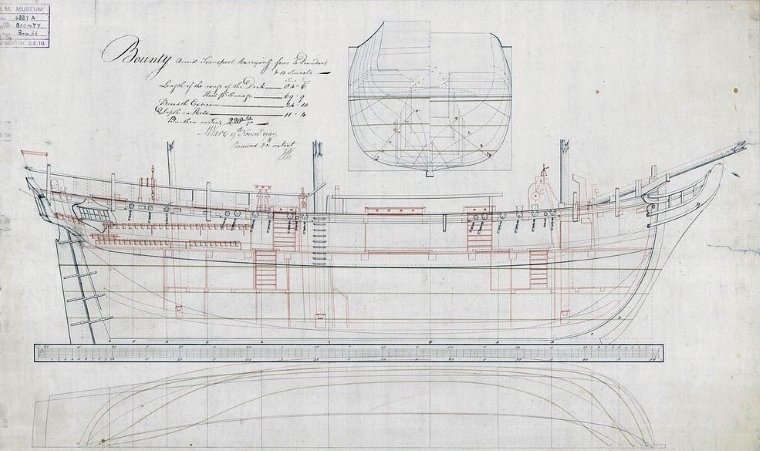
Now, let’s talk ship makeovers. When the Navy got their hands on the Bethia, they didn’t just slap on a new coat of paint and call it a day. Nope, they went all out. The ship was refitted stem to stern to prepare for its long journey.
First up, they ripped out a good chunk of the cargo hold to make room for all those breadfruit plants they were planning to collect. They installed a special cabin on the quarterdeck – think of it as a floating greenhouse – complete with skylights to keep those precious plants happy and healthy on the long voyage back.
But it wasn’t all about the plants. The Navy also beefed up the ship’s defenses, because let’s face it, the high seas weren’t exactly a friendly place back then. They added gun ports and armed the Bounty with four short four-pounder carriage guns and ten half-pounder swivel guns. Not exactly a floating fortress, but enough to make any would-be attackers think twice.
By the Numbers: Specifications of the Bounty
Alright, for all you nautical nerds out there (and we know you’re out there), let’s break down the Bounty by the numbers:
- Length: 90 feet 10 inches (27.7 m)
- Beam (width): 24 feet 4 inches (7.4 m)
- Depth of hold: 11 feet 4 inches (3.5 m)
- Tonnage: 230 tons
Now, in today’s world of massive cruise ships, the Bounty might sound like a bathtub toy. But back in the late 18th century, this was a respectable size for a naval vessel. It was big enough to carry a decent crew and cargo, but small enough to be nimble and efficient.
Cannons and Swivels: Armament
We touched on this earlier, but let’s dive a bit deeper into the Bounty’s teeth. As mentioned, she wasn’t exactly a warship, but she wasn’t defenseless either. Here’s what she was packing:
- 4 short four-pounder carriage guns: These were your main guns, capable of lobbing a four-pound iron ball at any ne’er-do-wells who might try to cause trouble.
- 10 half-pounder swivel guns: These smaller guns were mounted on the ship’s rails and could swivel around (hence the name). They were great for close-quarters defense or taking potshots at smaller targets.
It might not sound like much, but for a ship whose primary mission was to transport plants, it was enough to make potential pirates think twice before trying anything funny.
The Bounty’s Motley Crew
No ship is complete without its crew, and the Bounty had quite the cast of characters. Let’s meet some of the key players:
- Lieutenant William Bligh: The captain of our story. A talented navigator with a reputation for being, shall we say, a bit of a hard-ass.
- Fletcher Christian: The master’s mate and eventual leader of the mutiny. Think of him as the Brad Pitt of the 18th-century sailing world (no, seriously, Pitt played him in a movie).
- 44 other crew members: A mix of experienced sailors, young adventurers, and a few folks who probably should have stayed on dry land.
All in all, the Bounty set sail with 46 men on board. That’s a lot of personalities to cram into a 90-foot ship for months on end. What could possibly go wrong?
Adventures on the High Seas: The Bounty’s Expeditions
Alright, now we’re getting to the good stuff. The Bounty’s main claim to fame was its breadfruit expedition, but let’s not get ahead of ourselves. Here’s a quick rundown of the ship’s adventures:
- The Great Breadfruit Mission: In December 1787, the Bounty set sail from England with a mission to collect breadfruit plants from Tahiti and transport them to the West Indies. Sounds simple enough, right?
- The Long and Winding Road: The journey to Tahiti was no cakewalk. It took the Bounty 10 months to reach its destination, including a failed attempt to round Cape Horn that forced them to take the long way around Africa.
- Tahitian Paradise: The crew finally reached Tahiti in October 1788. They spent five months there, collecting breadfruit plants and, well, enjoying the local hospitality. Let’s just say some of the crew got pretty comfortable with island life.
- The Ill-Fated Return: In April 1789, with a cargo hold full of potted breadfruit plants, the Bounty set sail for the Caribbean. But they never made it. Why? Well, that leads us to the most famous part of the Bounty’s story…
Mutiny on the Bounty: When It All Went South
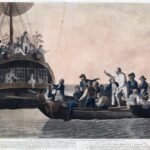
Picture this: It’s April 28, 1789. The Bounty’s been at sea for about three weeks since leaving Tahiti. The crew’s been grumbling, tension’s building, and then… boom! Mutiny!
Led by Fletcher Christian, a group of sailors decided they’d had enough of Captain Bligh’s harsh discipline and the lure of island life was too strong to resist. They took control of the ship, set Bligh and 18 loyal crew members adrift in a small boat, and turned the Bounty back towards Tahiti.
Now, you might think being set adrift in a tiny boat in the middle of the Pacific would be a death sentence. But Bligh, for all his faults, was one heck of a navigator. He managed to sail that little boat over 3,500 nautical miles to safety in Timor. Talk about an epic road trip!
Meanwhile, the mutineers tried to settle in Tahiti, but fearing the long arm of British naval justice, some of them, led by Christian, took off with a few Tahitian men and women. They eventually ended up on Pitcairn Island, where they burned the Bounty and settled down to live out their days.
The Final Voyage: The Ending and Wreck of the Original HMS Bounty
Now, you might be wondering, “What happened to the actual Bounty after all that mutiny business?” Well, grab your snorkel, because we’re about to take a deep dive into the Bounty’s watery grave.
After the mutineers reached Pitcairn Island in January 1790, they found themselves in a bit of a pickle. They needed to stay hidden from the British Navy, who they knew would be none too pleased about the whole mutiny situation. But they also needed to make sure no one else could use the Bounty to give away their location. Talk about a rock and a hard place!
So, what did they do? In a decision that would make any maritime historian weep, they decided to burn the ship. That’s right, on January 23, 1790, the mutineers set fire to the Bounty and sank her in what is now called Bounty Bay.
But here’s where it gets interesting. For years, the exact location of the wreck was a mystery. It wasn’t until 1957 that the first physical evidence of the Bounty’s watery grave was discovered. Luis Marden, a photographer and writer for National Geographic, found some of the Bounty’s remains in shallow water in Bounty Bay.
What did he find, you ask? Well, it wasn’t exactly a fully intact ship (that would have been too easy, right?). Marden discovered a ballast stone, an anchor, and a ship’s fitting. These might not sound like much, but in the world of nautical archaeology, they were like striking gold.
Since then, other expeditions have recovered more artifacts from the wreck site. We’re talking about things like the ship’s rudder pintles (the pins that hold the rudder in place), wooden planking, and even some of the ship’s cannons. Talk about buried treasure!
But don’t go planning your diving expedition just yet. The site of the Bounty’s wreck is now protected under UNESCO’s Convention on the Protection of Underwater Cultural Heritage. This means it’s off-limits to treasure hunters and souvenir seekers. It’s all about preserving history, folks.
The wreck of the Bounty serves as a tangible link to this incredible story. It’s a reminder that beneath the waves of Bounty Bay lies not just the remains of a ship, but the final chapter of one of the most famous tales in maritime history.
The Bounty Lives On: Modern Reconstructions
The original Bounty may have gone up in flames, but its legacy lives on through various reconstructions and replicas:
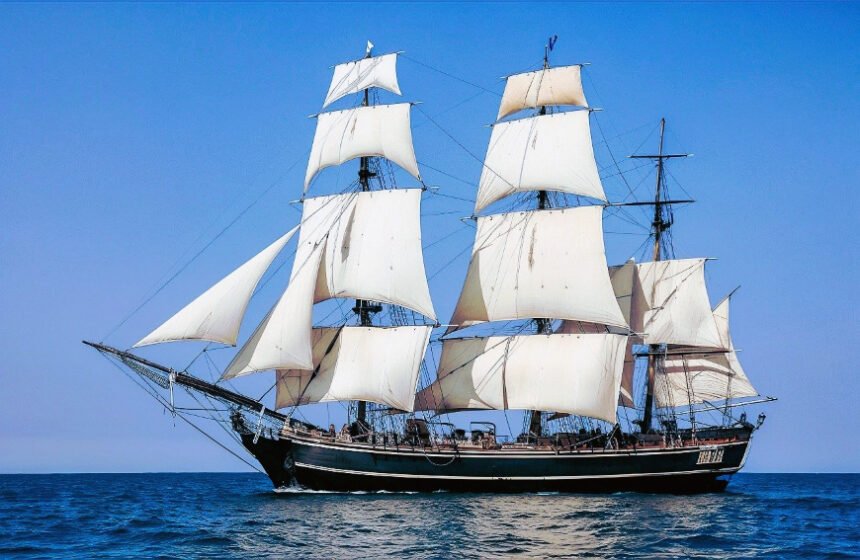
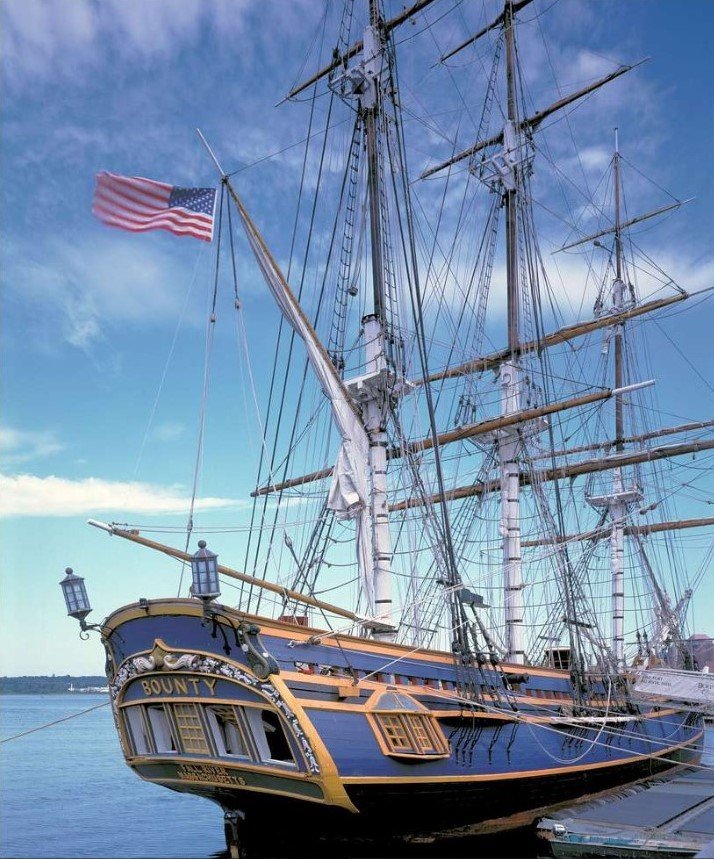
- HMS Bounty (1960): Built for the 1962 film “Mutiny on the Bounty,” this replica sailed the world for over 50 years before tragically sinking during Hurricane Sandy in 2012.
- Bounty III: A smaller replica built in New Zealand in 1979, used in the 1984 film “The Bounty.”
- HMS Bounty (Guangzhou): A Chinese-built replica launched in 2007, now used for tourist excursions.
These modern Bounties have helped keep the ship’s story alive, allowing new generations to experience a taste of 18th-century sailing life (minus the scurvy and floggings, thankfully).
The Bounty’s Enduring Legacy
The tale of the Bounty has captured imaginations for over two centuries, inspiring countless books, movies, and even a few rock songs. But beyond pop culture, the Bounty’s story has left a lasting mark:
- Pitcairn Island: The tiny island where the mutineers settled is still inhabited by their descendants, a unique community with its own distinct culture.
- Naval Reforms: The mutiny led to some soul-searching in the British Navy, eventually contributing to reforms in shipboard conditions and discipline.
- Breadfruit: Oh yeah, remember those plants? While the Bounty’s mission failed, later expeditions successfully introduced breadfruit to the Caribbean, where it remains an important food crop.
- Nautical Slang: The phrase “bounty hunter” originated from the search for the Bounty mutineers. Talk about leaving a linguistic legacy!
Wrapping It Up: The Bounty’s Place in History
As we furl our sails and bring this voyage to an end, let’s reflect on the legacy of the H.M.S. Bounty. What started as a simple cargo mission turned into one of the most famous nautical stories of all time. It’s a tale that has it all – adventure, rebellion, tropical paradises, and daring escapes.
The Bounty’s story reminds us of the complex realities of colonial expansion, the harsh conditions of 18th-century seafaring, and the very human desires for freedom and a better life that drove the mutineers to their fateful decision.
But perhaps most importantly, the Bounty’s tale continues to captivate us because it’s ultimately a human story. It’s about leadership and loyalty, discipline and desire, the clash between duty and dreams. It’s a reminder that even in the vast expanse of the ocean, it’s the choices we make and the relationships we forge that truly shape our destinies.
So the next time you bite into a piece of breadfruit or hear someone mention a “bounty hunter,” spare a thought for that small ship and its crew. Their journey may have ended long ago, but the ripples they created continue to shape our world in surprising ways. And who knows? Maybe there’s a little bit of mutineer in all of us, yearning for our own tropical paradise. Just maybe leave the actual mutiny part out of it, okay?