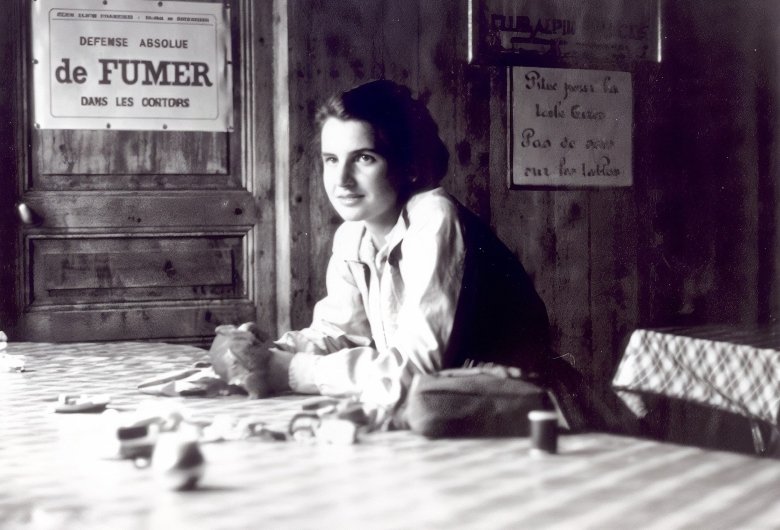
In the annals of scientific history, few stories are as compelling and controversial as that of Rosalind Franklin. A brilliant chemist and X-ray crystallographer, Franklin played a crucial role in one of the most significant scientific discoveries of the 20th century: the structure of DNA. Yet, for many years, her contributions were overshadowed and underappreciated. This article delves into the life, work, and legacy of Rosalind Franklin, shedding light on her invaluable contributions to science and the challenges she faced as a woman in a male-dominated field.
Rosalind Franklin : Early Life and Education
Rosalind Elsie Franklin was born on July 25, 1920, in London, England, into a prominent Jewish family. From an early age, Franklin displayed a keen intellect and a passion for science. Her aunt, Helen Bentwich, once remarked, “Rosalind is alarmingly clever – she spends all her time doing arithmetic for pleasure, and invariably gets her sums right.”
Franklin’s academic journey led her to Newnham College, Cambridge, where she studied chemistry. Despite the challenges faced by women in higher education at the time, she excelled in her studies, graduating in 1941. Her undergraduate research on the porosity of coal would later prove invaluable to the British war effort during World War II.
Career and Contributions to Science
X-ray Crystallography and DNA
After completing her Ph.D. at Cambridge in 1945, Franklin honed her skills in X-ray crystallography in Paris. This technique would become the cornerstone of her most significant scientific contributions. In 1951, she joined King’s College London, where she was assigned to work on the structure of DNA.
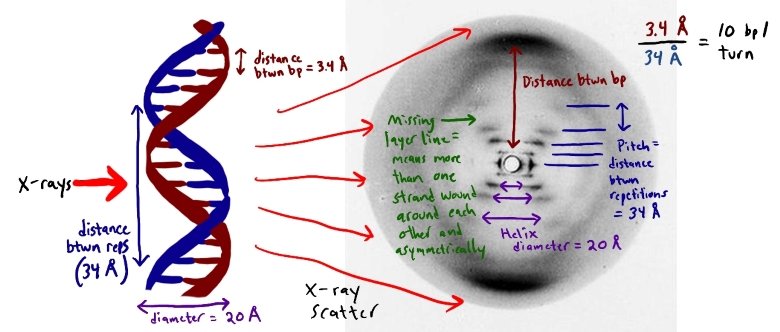
Franklin’s meticulous approach and expertise in X-ray crystallography led to the production of high-quality diffraction images of DNA. Her most famous image, known as “Photograph 51,” captured a clear X-ray diffraction pattern of DNA. This image was instrumental in deciphering the double helix structure of DNA.
The Controversy
The story of DNA’s structure is incomplete without mentioning the controversy surrounding Franklin’s work. While she was diligently working on unraveling DNA’s secrets, James Watson and Francis Crick were also pursuing the same goal at Cambridge University. In a turn of events that has been debated for decades, Watson and Crick gained access to Franklin’s unpublished data, including Photograph 51, without her knowledge or consent.
This information proved crucial in their development of the correct model of DNA’s structure. Watson, Crick, and Franklin’s colleague Maurice Wilkins went on to receive the Nobel Prize in Physiology or Medicine in 1962 for their discovery. Tragically, Franklin had passed away four years earlier and was ineligible for the award, as Nobel Prizes are not awarded posthumously.
Beyond DNA: Franklin’s Other Scientific Contributions
While Franklin is best known for her work on DNA, her scientific contributions extend far beyond this single achievement. After leaving King’s College London in 1953, she embarked on groundbreaking research at Birkbeck College on the structure of viruses.
Her work on the tobacco mosaic virus (TMV) was particularly significant. Franklin and her team used X-ray crystallography to determine the structure of TMV, revealing that the virus’s genetic material was embedded in its protein coat. This discovery laid the groundwork for modern virology and has had far-reaching implications for understanding viral infections and developing treatments.
Franklin also made important contributions to the study of coal and graphite structures. Her early work on the porosity of coal helped improve gas mask filters during World War II, potentially saving countless lives.
Personal Life and Challenges
Throughout her career, Franklin faced numerous challenges as a woman in science. In the 1950s, King’s College London segregated its dining rooms by gender, and women were not allowed in the senior common room where many scientific discussions took place. These barriers often left Franklin isolated from her male colleagues and excluded from informal scientific exchanges.
Despite these obstacles, Franklin remained dedicated to her work and maintained high standards for herself and others. She was known for her directness and unwillingness to speculate beyond the available data, traits that sometimes led to conflicts with colleagues but also earned her respect in the scientific community.
Legacy and Recognition
Rosalind Franklin passed away on April 16, 1958, at the young age of 37, due to ovarian cancer. Her early death robbed the scientific world of a brilliant mind and further contributions to molecular biology.
In the years following her death, Franklin’s role in the discovery of DNA’s structure has gained increasing recognition. Numerous books, documentaries, and even a play have been produced to tell her story and highlight her contributions to science.
Today, many institutions honor Franklin’s memory:
- The Rosalind Franklin University of Medicine and Science in North Chicago, Illinois, was named after her in 2004.
- The Rosalind Franklin Institute, a national research institute in the UK dedicated to developing new technologies to address challenges in the life sciences, was established in her honor.
- The European Space Agency named its Mars rover, part of the ExoMars mission, “Rosalind Franklin” in recognition of her contributions to our understanding of the molecular structures of DNA, RNA, viruses, coal, and graphite.
Conclusion
Rosalind Franklin’s story is one of brilliance, perseverance, and the pursuit of scientific truth. Her work laid the foundation for our understanding of molecular structures, from DNA to viruses, and continues to influence scientific research today. While her contributions were not fully recognized during her lifetime, Franklin’s legacy serves as an inspiration to scientists around the world, particularly women in STEM fields.
As we reflect on Franklin’s life and work, we are reminded of the importance of collaboration, ethical conduct in research, and the recognition of all contributors in scientific discoveries. Rosalind Franklin’s story encourages us to look beyond the headlines and celebrate the often unsung heroes whose dedication and brilliance push the boundaries of human knowledge.
In honoring Rosalind Franklin, we not only pay tribute to a remarkable scientist but also reaffirm our commitment to fostering an inclusive and equitable scientific community where talent and hard work are recognized regardless of gender or background. Her legacy continues to inspire generations of scientists to pursue truth, maintain integrity, and push the boundaries of human knowledge.