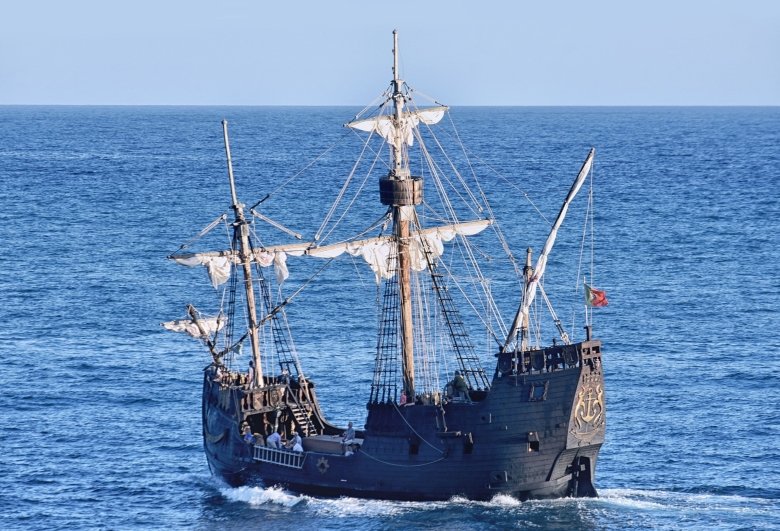
The Santa María, or La Gallega, stands as one of the most iconic ships in history. Famously used by Christopher Columbus during his 1492 voyage to the New World, this humble vessel carried explorers into the unknown, changing the course of history forever. While its role was pivotal, the Santa María’s story is one of both mystery and adventure, revealing much about naval exploration during the Age of Discovery.
The History of the Santa María
The Santa María wasn’t originally built for exploration. In fact, she began her life as a merchant ship called La Gallega due to her origin in the Galicia region of Spain. Constructed in the latter half of the 15th century, she was sturdy, dependable, and designed to navigate the rugged waters of the Atlantic. It wasn’t until 1492 that the ship would gain international fame when it was chartered for Columbus’s westward expedition. Of the three ships in the fleet, the Santa María was the largest and served as the flagship, leading the Pinta and the Niña on their journey.
Columbus himself, though a skilled navigator, didn’t necessarily favor the Santa María. He often remarked that she was sluggish compared to the nimbler caravels. Still, her large cargo capacity made her essential for transporting provisions and people during the long voyage. It was on the Santa María that Columbus made his first encounters with the islands of the Caribbean, setting the stage for the European colonization of the Americas.
Design and Development
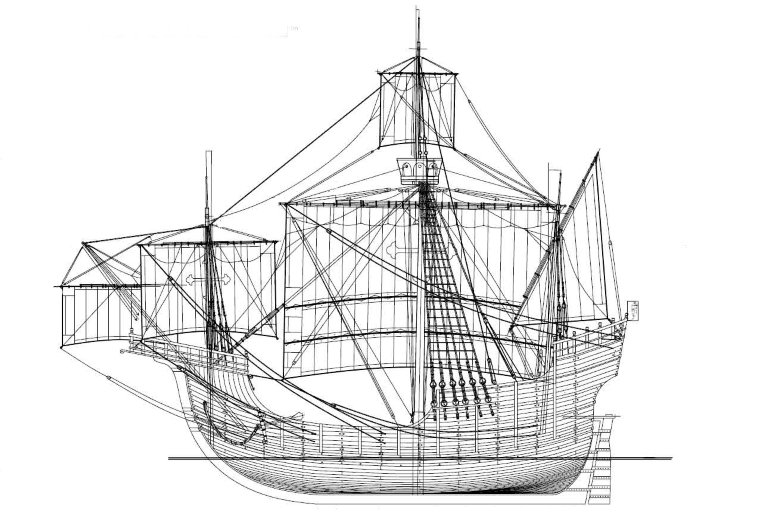
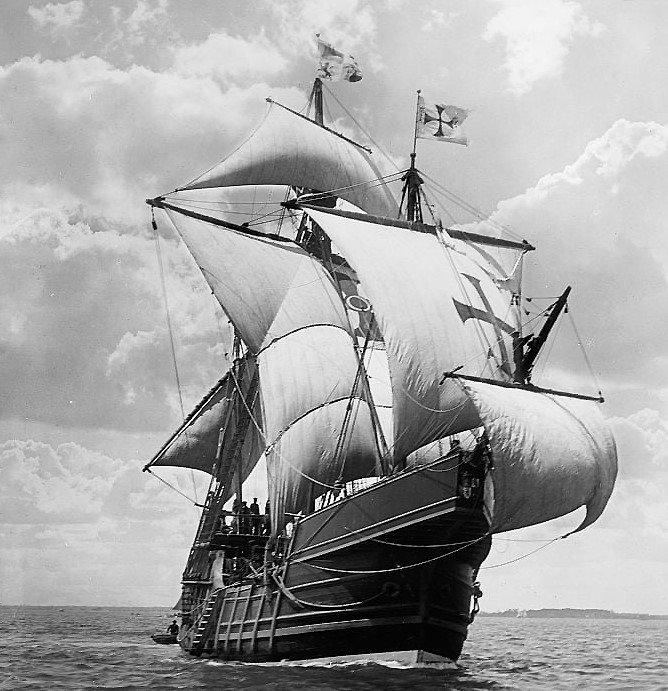
The Santa María was a nao, a type of ship widely used by merchants in Spain. Naos were prized for their robustness and ability to handle long-distance voyages. The ship had a full-bodied, round hull, which gave her stability but reduced her speed.
- Length: Approximately 70 feet (21 meters).
- Beam (Width): Around 25 feet (7.9 meters).
- Draft (Depth below waterline): 7 feet (2.1 meters).
Her size was modest by today’s standards, but in the late 15th century, she was considered a large vessel. The Santa María was fitted with three masts—the main mast, foremast, and mizzenmast—and square sails on the fore and main masts for catching the wind on open seas, while a smaller triangular lateen sail on the mizzenmast allowed for better control when navigating coastlines or rivers.
As a cargo ship, her primary function was to transport goods, not people. This is why Columbus’s crew faced cramped conditions during the voyage. Unlike the more maneuverable caravels, the Santa María had no significant agility in battle or when exploring coastlines.
Specifications
- Type: Nao (merchant ship).
- Tonnage: Estimated at 100 tons.
- Length: Approximately 70 feet (21 meters).
- Width (Beam): Around 25 feet (7.9 meters).
- Sails: Three masts with square and lateen sails.
- Speed: Approximately 4 knots (about 7.4 km/h or 4.6 mph) under optimal conditions.
Though slow, the Santa María’s durability and size made her ideal for carrying provisions across the Atlantic, helping ensure that the crew had enough supplies for what was then an unprecedented voyage.
Armament
Though not a warship, the Santa María wasn’t completely unarmed. Given the potential dangers of encountering hostile vessels or pirates, the ship carried some basic weaponry. The armament was minimal but necessary for defense.
- Cannon: The ship carried small cannons, likely culverins, which were long-barreled guns typically used in naval warfare during the 15th century. They weren’t intended for ship-to-ship combat but could have been used to fend off smaller boats or intimidate potential threats.
- Crossbows: Crew members were also equipped with crossbows, a common weapon of the time, providing further protection from attackers or in interactions with indigenous peoples.
However, the Santa María’s true strength wasn’t in her firepower but in her endurance and ability to handle long, treacherous journeys across the open ocean.
The Crew
The crew of the Santa María was diverse, numbering about 40 men. In total, Columbus’s fleet of three ships carried 90 crew members. Many were seasoned sailors, accustomed to the challenges of the sea, while others were more familiar with coastal trade and exploration.
- Christopher Columbus himself served as the fleet’s commander, overseeing the journey from the Santa María. He was a skilled navigator with an unshakeable belief that he could reach Asia by sailing west.
- Juan de la Cosa was the ship’s owner and master, handling the day-to-day operations aboard the Santa María. He was instrumental in the ship’s safe passage and eventual discovery of the New World.
- Rodrigo de Triana was a crew member who famously spotted land for the first time, crying out, “Land ho!” on the morning of October 12, 1492.
Life aboard the ship was tough. Crew members had to deal with cramped quarters, limited food, and the constant threat of storms. Despite the harsh conditions, the sailors maintained their course, driven by the hope of discovering new lands and treasures.
The Santa María’s Legacy
The legacy of the Santa María is inextricably tied to Columbus’s first voyage to the New World. However, the ship’s fate was far less glorious than its historical significance. On December 25, 1492, the Santa María ran aground off the coast of present-day Haiti. Efforts to refloat the ship failed, and she had to be abandoned. Columbus and his crew dismantled parts of the ship and used them to build a fort, La Navidad, where some of the crew stayed behind as Columbus returned to Spain on the smaller Niña.
Although the Santa María didn’t survive the return trip, her impact on world history is undeniable. The voyage she led opened the door to further exploration and the eventual colonization of the Americas. She symbolizes the spirit of adventure, exploration, and the risks taken by those who sought to expand the known world.
Conclusion
The Santa María may not have been the swiftest or the most formidable ship of her time, but her role in shaping the future of the world is unparalleled. As Columbus’s flagship, she carried the hopes of an entire expedition into the unknown, crossing uncharted waters to find a world that would never be the same again. From her humble origins as a merchant vessel to her tragic end on the shores of the Caribbean, the Santa María’s legacy endures, reminding us of the daring voyages that defined the Age of Exploration.