




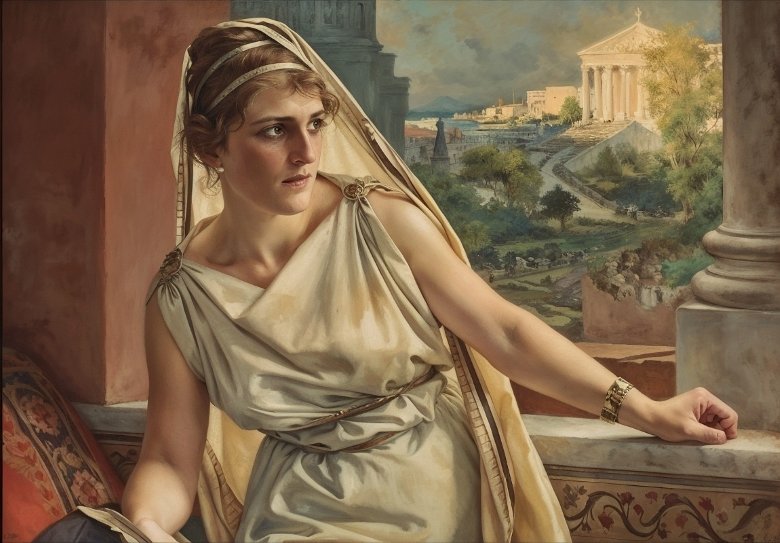
In the twilight of the Roman Empire, a woman’s intellect shone brightly in Alexandria, Egypt. Hypatia (Υπατία) , a mathematician, astronomer, and philosopher, defied the conventions of her time to become one of the ancient world’s most renowned scholars. Her tragic fate would echo through history, making her a symbol of free thought and scientific inquiry.
Early Life and Education
Born around 355-370 CE, Hypatia grew up in Alexandria, a city famed for its Great Library and intellectual atmosphere. Her father, Theon, was a prominent mathematician and astronomer who ensured his daughter received an education rivaling that of any man.
Under her father’s tutelage, Hypatia’s brilliant mind flourished. She mastered mathematics, astronomy, and philosophy, surpassing even her accomplished father in many areas. Her insatiable curiosity and analytical skills set the stage for a life dedicated to knowledge and teaching.
A Female Scholar in a Man’s World
In an era when women were largely excluded from academic pursuits, Hypatia broke barriers. She became the head of the Neoplatonist school in Alexandria, attracting students from across the empire. Her lectures on mathematics, astronomy, and philosophy were said to be captivating, drawing crowds of eager learners.
Hypatia’s reputation spread far beyond Alexandria. Scholars sought her advice on complex mathematical problems, and she corresponded with intellectuals throughout the Mediterranean world. Her students included pagans, Christians, and Jews, a testament to her inclusive approach to education and her ability to transcend religious boundaries.
Contributions to Science and Philosophy
Hypatia’s work spanned several fields:
- Mathematics: She wrote commentaries on Diophantus’ Arithmetica, advancing algebraic thought. Her work on conic sections was particularly noteworthy.
- Astronomy: Hypatia improved the design of the astrolabe, an ancient astronomical instrument. She also may have edited Ptolemy’s Almagest, the preeminent astronomical text of the time.
- Philosophy: As a Neoplatonist, Hypatia taught a philosophy that combined Platonic idealism with mystical elements. Her teachings emphasized the pursuit of knowledge as a path to understanding the divine.
A Life of Innovation and Invention
Beyond her theoretical work, Hypatia was known for her practical inventions. She developed an improved version of the hydrometer, used for determining the relative density of liquids. This invention had practical applications in medicine and trade, showcasing Hypatia’s ability to bridge the gap between abstract thought and real-world problems.
Her work on the astrolabe made this complex instrument more accessible, aiding in navigation and timekeeping. These contributions highlight Hypatia’s multifaceted intellect and her desire to make knowledge useful and accessible.
Political Influence and Tragic End
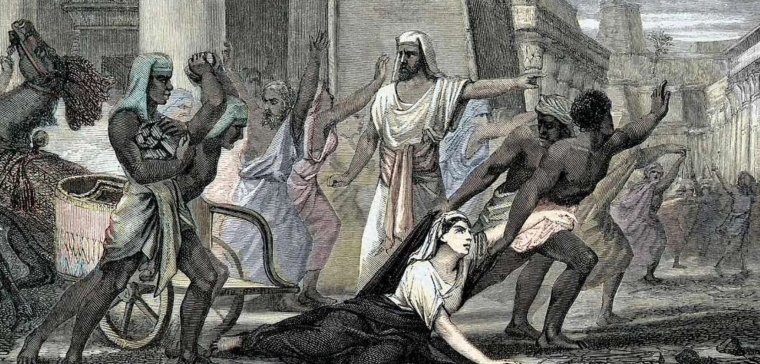
Hypatia’s brilliance and charisma earned her significant influence in Alexandria. She advised Orestes, the Roman prefect of Egypt, on political matters. This role, combined with her pagan beliefs, unfortunately made her a target in the increasingly tense religious climate of the time.
In 415 CE, during a period of conflict between Orestes and Cyril, the Christian bishop of Alexandria, Hypatia became a scapegoat. A mob of Christian zealots attacked her, brutally murdering her in a shocking act of violence that sent shockwaves through the intellectual world.
Legacy and Impact
Hypatia’s death marked the end of an era. It symbolized the decline of classical learning and the rise of religious dogmatism that would characterize much of the early Middle Ages. Yet, her legacy lived on:
- Symbol of Learning: Hypatia became an enduring symbol of the pursuit of knowledge in the face of ignorance and intolerance.
- Inspiration for Women in Science: Her life has inspired generations of women to pursue careers in mathematics, science, and philosophy.
- Cultural Icon: Hypatia’s story has been retold in literature, art, and film, keeping her memory alive across the centuries.
- Scientific Legacy: While much of her work has been lost, her contributions to mathematics and astronomy laid groundwork for future scholars.
Hypatia in Modern Times
In recent years, there has been a resurgence of interest in Hypatia. Scholars have re-examined her life and work, shedding new light on her contributions to science and philosophy. She has become a symbol of rational thought and women’s empowerment, featured in popular books, documentaries, and even a major film.
Hypatia’s life serves as a reminder of the timeless value of education, critical thinking, and the pursuit of knowledge. In an age of information overload and ideological divisions, her commitment to reason and her ability to teach across cultural and religious boundaries offer valuable lessons.
Conclusion: A Star That Still Shines
Hypatia of Alexandria lived in turbulent times, much like our own. Her dedication to learning, her innovative spirit, and her courage in the face of intolerance continue to inspire. As we face the challenges of the 21st century, Hypatia’s life reminds us of the power of education, the importance of bridging divides, and the enduring impact one brilliant mind can have on the world.
In Alexandria, where the ancient lighthouse once guided ships to harbor, Hypatia’s intellectual light guided minds to knowledge. Though her life was cut tragically short, her legacy as a teacher, scientist, and philosopher continues to illuminate the path for seekers of wisdom today.